



5 Costly Mistakes to Avoid When Buying Carrara Quartz Countertops (2026 Guide)
A critical buyer's guide for 2026 revealing the top 5 financial and aesthetic mistakes homeowners make when purchasing Carrara quartz, including seam visibility issues, UV discoloration, and through-body veining myths.
- Introduction
- Quick Summary: The Buying Checklist
- What Defines High-Quality Carrara Quartz?
- Mistake #1: Ignoring 'Through-Body' Veining Specifications
- Why This Costs You Money
- Mistake #2: Underestimating 'Seam Visibility' in Veined Slabs
- How to Avoid the "Chopped" Look
- Mistake #3: Choosing the Wrong White Tone for Your Cabinetry
- The Lighting Factor
- Mistake #4: Disregarding UV Discoloration Risks (Sunlight Damage)
- 2026 Protection Standards
- Mistake #5: Falling for the 'Honed Finish' Trap in High-Traffic Areas
- The Daily Reality of Honed Quartz
- Expert Tips: How to Inspect Your Slab
- Conclusion
- FAQ
- Does Carrara quartz stain like real marble?
- Is Carrara quartz cheaper than granite?
- Can I put hot pans directly on Carrara quartz?
- How do I hide seams in Carrara quartz?
- Does white Carrara quartz turn yellow over time?
- What is the best edge profile for Carrara quartz?
- Is honed or polished better for Carrara quartz?
- How often does Carrara quartz need sealing?
- References
Introduction
Carrara quartz has cemented its status as the premier choice for modern kitchens, with recent market data showing it captures nearly 60% of the premium countertop sector as of late 2025. Homeowners love it for offering the luxurious look of Italian marble without the high maintenance. However, the surge in demand has flooded the market with varying quality standards, leading to expensive regrets for uninformed buyers.
From mismatched veins that ruin expensive islands to shocking discoloration from sunlight, the risks are real. This guide exposes the 5 most costly mistakes to avoid when investing in Carrara white quartz, ensuring your 2026 kitchen renovation remains pristine for decades.
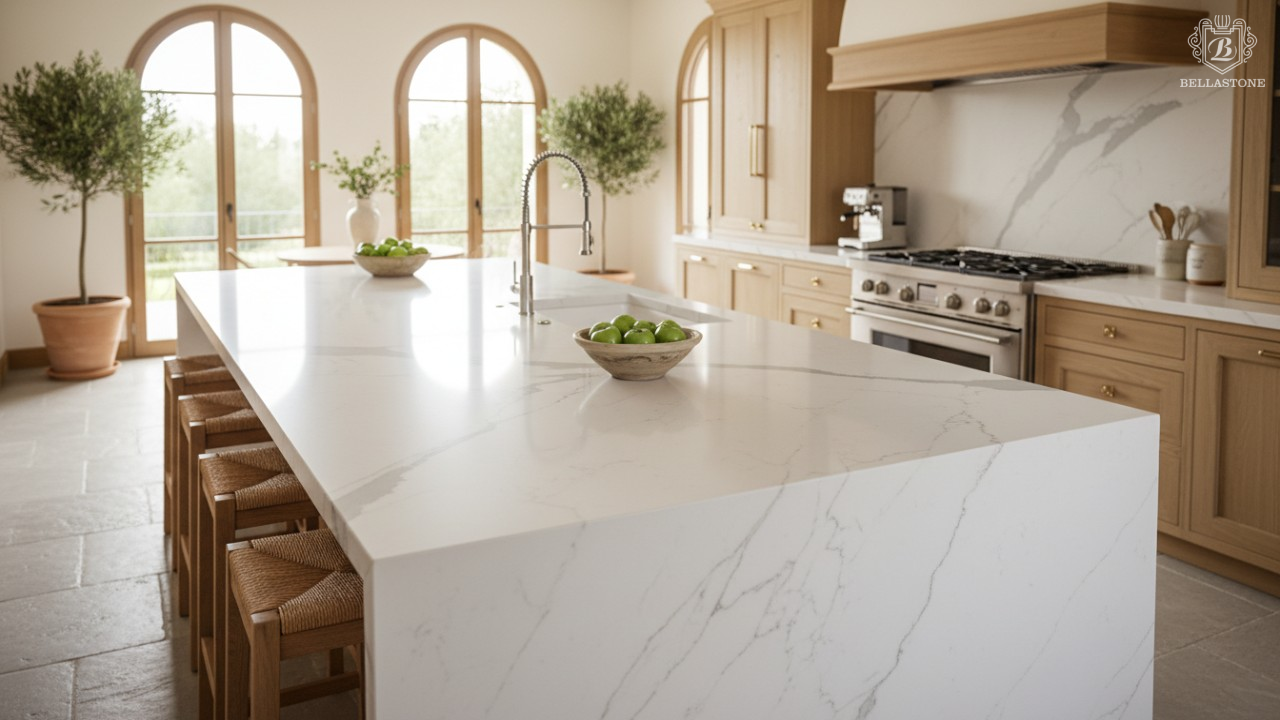
Quick Summary: The Buying Checklist
If you are in a rush to visit the stone yard, here is the critical "Cheat Sheet" to save you from financial loss.
|
Mistake Category |
The Risk |
The Solution |
|
Pattern Depth |
"Printed" veins disappear at the edge. |
Buy Through-Body slabs only. |
|
Seam Visibility |
Veins stop abruptly at seams. |
Request a Digital Layout approval. |
|
Color Tone |
Cool quartz clashes with warm cabinets. |
Test samples in 3000K & 5000K lighting. |
|
UV Damage |
Resin turns yellow in sunlight. |
Avoid direct window exposure or outdoor use. |
|
Finish Choice |
Honed finish shows oil spots. |
Stick to Polished for high-traffic kitchens. |
What Defines High-Quality Carrara Quartz?
Carrara Quartz is an engineered stone surface composed of approximately 90-93% natural quartz aggregates and 7-10% polymer resins, designed to mimic the soft grey veining of natural Italian marble without the porosity.
To ensure you are getting a durable product, you must look beyond the price tag. High-quality quartz stone ranks 7.0 on the Mohs hardness scale, making it significantly more scratch-resistant than natural marble (which ranks at 3.0). However, the true mark of quality in 2026 lies in the manufacturing technology:
· Bretonstone Technology: The gold standard for compaction, reducing porosity to nearly zero.
· Through-Body Veining: Ensures the pattern exists throughout the slab, not just printed on top.
· UV Stabilization: Newer 2025 formulations include additives to delay resin breakdown.
For a deep dive into technical specifications, read our Comprehensive technical guide to Carrara white quartz for buyers.
Mistake #1: Ignoring 'Through-Body' Veining Specifications
Buying "printed" quartz slabs where the vein pattern only exists on the top millimeter of the surface is the number one aesthetic error homeowners make.
When you cut a standard edge profile (like a Bullnose or Bevel) on a printed slab, the grey Carrara marmi quartz veining disappears, leaving a plain white stripe that looks visibly fake. This dead giveaway cheapens the entire look of the kitchen.
Why This Costs You Money
To hide a printed pattern's lack of depth, fabricators must use a "Mitered Edge" (cutting the stone at 45-degree angles to fold the pattern down).
· Standard Edge Cost: Included or minimal.
· Mitered Edge Cost: Adds $40–$80 per linear foot due to labor intensity.
The Fix: Always verify the slab specification is "Through-Body" or "Full-Body." This allows you to use standard, affordable edge profiles while maintaining the realistic look of natural stone.
Mistake #2: Underestimating 'Seam Visibility' in Veined Slabs
Unlike granular granite, Bianco Carrara quartz has distinct directional flow lines that are notoriously difficult to match at seam points.
A common disaster occurs when two slabs meet at a corner, and the heavy grey veins dead-end into white space. This breaks the visual illusion of stone and screams "engineered product."
How to Avoid the "Chopped" Look
1. Bookmatching: Purchase slabs that are mirror images of each other. This allows veins to flow continuously across seams, forming a diamond or butterfly pattern. Note that this often requires purchasing 20-30% more material to align the cuts.
2. Digital Layouts: never let a fabricator cut without approval. Demand a "Slabsmith" or digital rendering showing exactly where the seams will land on your specific carrara quartz countertop.
3. Seam Placement: Ensure seams are placed in low-visibility areas, such as through the sink cutout or cooktop, rather than the middle of a peninsula.
Mistake #3: Choosing the Wrong White Tone for Your Cabinetry
The "Clash Effect" happens when you pair a cool, blue-toned white Carrara quartz with warm, creamy-white cabinetry, making the cabinets look dirty or yellow.
Quartz carrara comes in hundreds of shades. Some use a bright, clinical white base (Cool), while others use a milky, soft white base (Warm).
The Lighting Factor
Your showroom visit is misleading because warehouse lighting (typically 5000K Daylight) makes all quartz look crisp white.
· Action Step: Bring a sample of your cabinet door and the quartz sample home.
· Test 1: View them under natural morning light.
· Test 2: View them under your kitchen's artificial lighting (usually 2700K or 3000K).
If you see a friction between the two whites, switch to a Carrara quartz with a "translucent" background, which tends to blend better with varied cabinet tones.
Mistake #4: Disregarding UV Discoloration Risks (Sunlight Damage)
Standard resin binders in white Carrara quartz countertops are not UV-stable and will permanently yellow if exposed to direct, unfiltered sunlight.
While quartz stone is durable, the 7-10% resin component is chemically sensitive to UV rays. This process, known as photo-oxidation, breaks down the polymer chains, turning your pristine white counters into a sickly amber hue over 2-5 years.
2026 Protection Standards
· Indoor Only: Never install standard quartz in an outdoor kitchen.
· Window Films: If your sink is in front of a south-facing window, install UV-blocking window film to protect the stone.
· Material Selection: If you have a sun-drenched room, ask for "High-UV Resistance" brands that use improved polymers introduced in late 2024.
According to recent industry reports, warranty claims for resin yellowing increased by 15% in 2024, largely due to misconceptions about quartz being "indestructible."
Mistake #5: Falling for the 'Honed Finish' Trap in High-Traffic Areas
Choosing a honed (matte) finish for a busy family kitchen often leads to "cleaning fatigue" because the textured surface traps oils and fingerprints.
A polished finish seals the micropores of the resin, creating a barrier against stains. A honed finish, while aesthetically trendy and natural-looking, leaves these micropores slightly more open.
The Daily Reality of Honed Quartz
· Oil Magnets: Fingerprints from cooking oils show up as dark blotches.
· Metal Marks: Sliding a pot across a matte surface can leave grey metal transfer marks that are hard to scrub off.
· Staining: Red wine and coffee require immediate wiping, whereas polished carrara quartz colors give you a longer grace period.
Recommendation: If you love the matte look, use it for a low-traffic bathroom vanity, but stick to Polished for the main kitchen workspace.
Expert Tips: How to Inspect Your Slab
Before you sign off on your Carrara white quartz, use these expert inspection techniques to ensure you aren't getting a "B-Grade" slab.
1. The Resin Pooling Check: Look for areas where the grey veining looks blurry or where there are white blotches (pools of resin with no quartz aggregate). This is a manufacturing defect.
2. Vertical Viewing: Ask the supplier to move the slab. Viewing it flat on an A-frame can hide surface warping.
3. Batch Matching: If you need 3 slabs, ensure the Batch Numbers are sequential. Quartz carrara batches can vary slightly in background whiteness, and a mismatch will be obvious at the seam.
For more details on finding reputable suppliers, read our guide on Sourcing Carrara Quartz.
Conclusion
Buying Carrara quartz countertops is a significant investment that creates the visual anchor of your home. By prioritizing through-body veining, respecting the limitations of resin against UV light, and critically evaluating the finish for your lifestyle, you can avoid the common pitfalls that plague uninformed buyers. In 2026, the technology is better than ever, but the responsibility still lies with the buyer to verify the quality.
FAQ
Does Carrara quartz stain like real marble?
No, it is non-porous and highly resistant to staining. Unlike marble, which requires sealing, quartz resin acts as a barrier. However, cheap generic brands with low resin quality can still be damaged by harsh chemicals like bleach or oven cleaner.
Is Carrara quartz cheaper than granite?
Generally, Carrara quartz is mid-range, often costing slightly more than entry-level granite ($50-$70/sq ft) but less than exotic granite. In 2025, the average installed cost for premium Carrara designs is between $90 and $130 per square foot.
Can I put hot pans directly on Carrara quartz?
No, the resin binder can melt or discolor (thermal shock) at temperatures above 300°F. Always use trivets. While the stone itself is heat resistant, the polymer that holds it together is not.
How do I hide seams in Carrara quartz?
Use a fabricator who utilizes a 'seam setter' and color-matched epoxy. For the best results with heavy veining, purchase "Bookmatched" slabs so the pattern continues across the seam, and approve a digital layout before cutting.
Does white Carrara quartz turn yellow over time?
It can if exposed to direct UV sunlight over many years. This is due to the polyester resin reacting to UV rays (photo-oxidation). Keep it indoors and away from unfiltered direct sun to maintain the crisp white color.
What is the best edge profile for Carrara quartz?
Eased or Pencil edges are modern and minimize chipping. If you want a fancy Ogee edge, you must ensure you have "Through-Body" veining, otherwise, the edge will look solid white and fake.
Is honed or polished better for Carrara quartz?
Polished is better for stain resistance and hiding smudges. Honed offers a beautiful matte look but holds onto oils and fingerprints, making it higher maintenance for daily cleaning.
How often does Carrara quartz need sealing?
Never. Unlike natural marble or granite, quartz surfaces are non-porous and do not require sealing. Cleaning with mild soap and water is sufficient for its lifespan.
References
· 2025 Countertop Trends: Quartz, Granite & Sustainable Designs


Care & Maintenace
Do I need to seal Bellastone quartz?
No sealing is required. Quartz surfaces are non-porous, making them resistant to stains, moisture, and bacteria by design.
How do I clean my quartz surface daily?
Simply use a soft cloth or sponge with mild soap and warm water. Avoid abrasive pads or harsh chemicals to maintain surface shine.
Printed Artificial Quartz Stone
Is it suitable for commercial projects?
Absolutely. Its uniform appearance, durability, and scalability make it ideal for hotels, offices, retail, and large construction projects.
FAQ
What is the minimum order quantity?
Minimum order quantity: 30 pieces.
Which is more expensive, artificial quartz stone or natural stone?
If we only consider the purchase price per square meter, artificial quartz stone is usually more expensive than ordinary granite but cheaper than top-grade marble. However, considering the total cost over the long term, the cost-effectiveness of durable artificial quartz stone that requires no maintenance may be higher; whereas marble, which requires regular professional maintenance, may be more expensive in terms of long-term total expenditure.


Whether you're exploring design trends or planning your next build, our team is here to support with product advice, pricing, and tailored solutions.
Rest assured that your privacy is important to us, and all information provided will be handled with the utmost confidentiality.
By clicking "Send Inquiry Now", I agree to your processing my personal data.
To see how to withdraw your consent, how to control your personal data, and how we process it, please see our Privacy Policy and Terms of Use.
Bellastone, Premium Quartz Manufacturer & Exporter
© 2026 BELLASTONE. All Rights Reserved. | Privacy Policy | Terms and Conditions | Sitemap
Facebook
Linkedin
YouTube